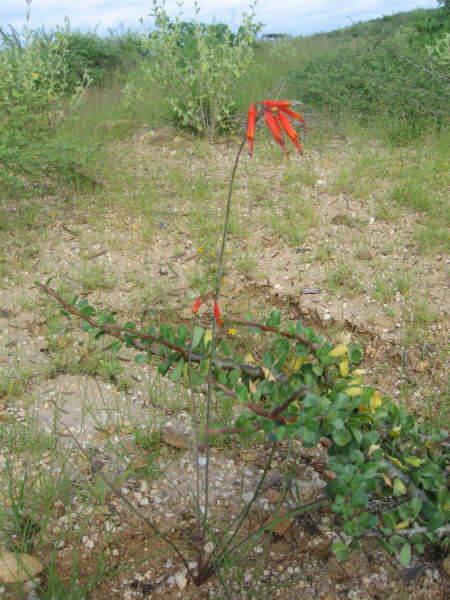
Behria Greene is a monospecific genus closely related to Bessera. It is native to southern Baja California, Mexico. Most authorities lump it in with Bessera. However, the authors of the 2004 retypification paper, botanists in the university at La Paz, Baja California Sur argue based on several aspects of the flowers and the plant that it is not the same genus. They have looked at live plants and mapped out many different locations where they are found for many decades. It is a member of the Milla clade in the Themidaceae family. (This clade includes Bessera, Dandya, Jaimehintonia, Milla, and Petronymphe).
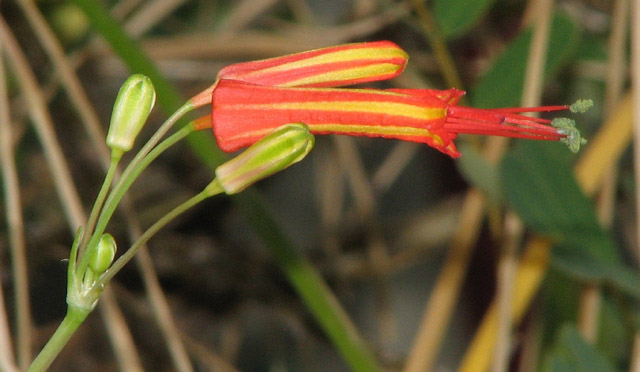
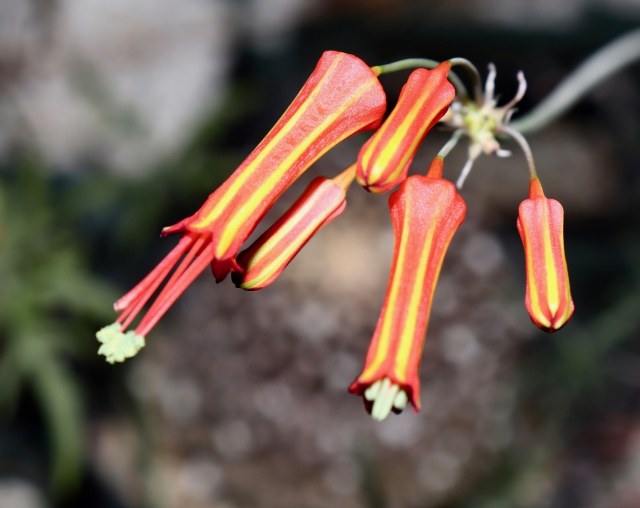
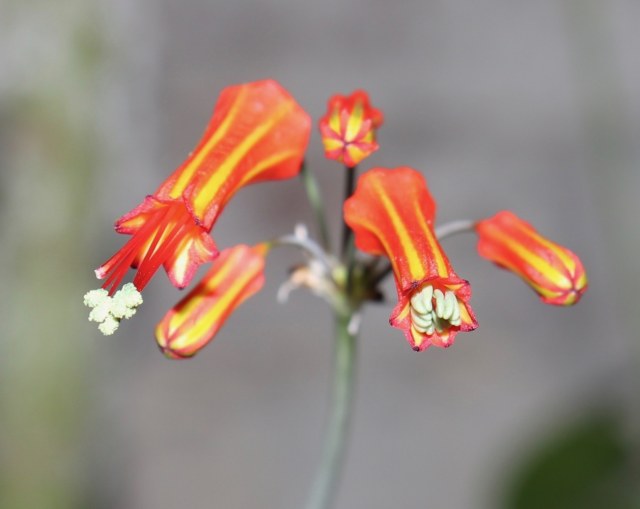
Behria tenuiflora Greene (syn. Bessera tenuiflora (Greene) J.F.Macbr.) is a beautiful and vivid wildflower endemic to the southern part of the Baja California peninsula, Mexico. The wild populations are distributed in an altitudinal range from the top of the mountains at 2200 m to practically sea level. It has remained exceedingly rare in cultivation. The flowers appear as early as August, but more typically in Sept-Oct. and are especially striking up close with a combination of orange-red ground color, yellow stripes and green pollen. As with most of western Mexico, the Cape region of Baja California is subject to summer monsoon rains and this provides clues as to how to handle this species in cultivation. Dylan Hannon has found this to be an unpredictable plant that may not sprout until very late (Aug-Sept), long after its cousins like Milla and Bessera are well along in growth or flowering. Corresponding to this late emergence, the leaves of Behria can remain green well into winter and seem to enjoy the cool down. In a given year some or all of the corms may not sprout at all. Height range: to about 30 cm. The photo below shows pictures from a plant originally collected by Myron Kimnach, MK 3158, grown and photographed by Dylan Hannon.
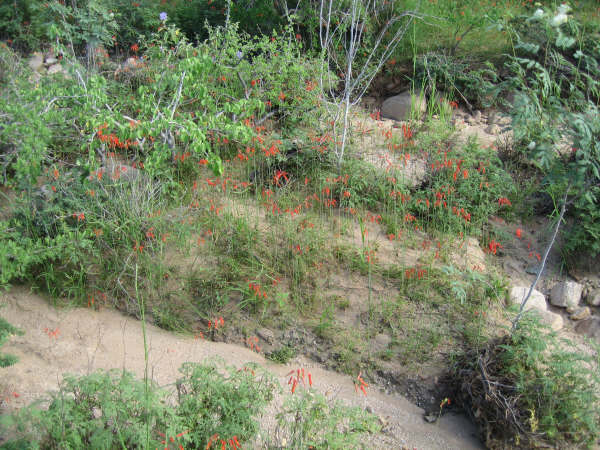
The following two photos were taken near Todos Santos, BCS, Mexico in early autumn 2006 by Darren Sage. The plants shown in these photos were described thusly: "They were a colony of about 300-400 plants growing in sandy soil in and around a small dry river bed (2-3 m wide). The hurricane 2 weeks before, and occasional summer thunderstorms, must have briefly filled the stream and triggered them into action. The river is unlikely to have run more than a day or two (at least on the surface). They had little corms like crocus, but gave the impression of an Allium without the smell. The colourful tubular flowers suggests hummingbird pollination. This area may get a little light, but rare, rain during the autumn and winter too, but usually looks like a semi arid area. There is usually no rain at all March-May. So significant rain only comes in summer, usually June-September."